
Introduction
Creation is not the result of an accident, nor a reaction to anything external to God. It is the direct consequence of God’s own will, which is identical to His essence. This article explores how God, willing from His own being, unfolds reality from absolute non-being (Ayin) through a process of emanation, forming not only our universe but infinite worlds, structured through the Sefirot and sustained by the Infinite Light.
1. God’s Will Grows Internally — Will as Living Essence
God does not merely have will — He is Will. Will is not an attribute, instrument, or faculty applied to the world. It is God’s essence as living self-determining reality. In God, to be is to will, and to will is not simply to act outward, but to advance inwardly. Divine will is not static fullness; it is fullness that surpasses itself. God does not remain identical by remaining still, but by being capable of becoming more without ceasing to be fully Himself.
This growth is not growth from lack, repair, or incompletion. God does not gain what He did not have. Rather, no state of God exhausts what God can be, not even for God Himself. Each articulation of divine will is complete, yet none is final. God grows because His will is not containable by any prior self-determination. Growth here means increase in actuality without increase in deficiency — a paradoxical excess where fullness refuses closure.
Divine will does not move toward goals the way human will does. It does not begin with an end already known. God’s will moves before aims exist, generating aims by moving. It is not directed toward form; form precipitates from it. Like a fire that intensifies by burning, or a mind that deepens by thinking, God’s will advances by willing. Its motion is not toward something missing, but beyond what has already been.
As God’s will advances through Himself, it generates new internal actualities — not remnants or leftovers, but newly real determinations of divine life. These are not stored ideas or latent contents waiting to be uncovered. They are newly actual layers of God’s own being, arising because will has surpassed its prior articulation. One can imagine this paradoxically as an infinite depth opening within infinity itself: every advance reveals that God was always deeper than even His own self-expression.
This is not discovery in the sense of ignorance. God does not learn what He did not know. Rather, God knows by making real. Divine awareness does not precede will; it accompanies it. God’s knowing is the luminous side of will’s advance, not a spectator of it. What becomes newly actual within God is known because it is now real, not because it was previously hidden.
And yet, God’s will is not only spontaneous overflow. It is also capable of intention. The same will that surpasses itself freely can also turn back toward what has been, not as repetition, but as elevation. God may re-will, refine, or re-enter prior articulations, not because they were insufficient, but because will is capable of resonance as well as novelty. Even when God revisits Himself, He does so from beyond Himself, never repeating without difference. Nothing in God returns unchanged.
Thus, God’s will truly grows — internally, essentially, and endlessly — not by adding parts or repairing lack, but by becoming more actual than it was, while remaining fully God at every stage. This internal growth is the deepest meaning of divine life.
2. From Internal Growth to External Manifestation — Ayin and Ein Sof
Because God’s will truly advances within Himself, creation is not an afterthought. External reality is the echo and extension of internal divine growth. What God becomes inwardly cannot remain sealed within God, because will that surpasses itself necessarily presses beyond itself. The inner advance of God’s will generates the conditions for outward manifestation.
For anything distinct to appear, however, distinction must first be possible. God is infinite being; nothing can stand outside Him unless He wills a form of concealment. This is not withdrawal from lack, but restraint from abundance. God veils His overflowing actuality so that what is not God may appear. This veiling is known as tzimtzum — not a removal of God, but a self-withholding of immediacy.
The result of this self-withholding is Ayin — “nothing,” not as non-being, but as no-thing. Ayin is the zone where God’s internal growth no longer appears as God, but has not yet appeared as something. It is the shadow cast by divine excess. Ayin is not empty; it is saturated with the pressure of divine life that has not yet taken form. It is the paradoxical space where God is hidden precisely because He is too present.
Ayin is fed continuously by God’s internal advance. As divine will generates new internal actualities, these are not immediately stabilized as forms. They pass through Ayin as indeterminate resonance — not possibilities stored in advance, but newly born intensities seeking articulation. Ayin is therefore not a container, but a threshold: the moment where inner divine growth becomes capable of outward expression.
From Ayin, God draws forth Yesh — determinate being. This drawing is not imposition from above, but extraction from within. Order, structure, and meaning are not forced onto chaos; they are distilled from divine excess. As God’s light — Or Ein Sof — pours outward, it does so along channels shaped by His own self-surpassing will. These channels become the Sefirot, the first stable articulations through which creation can emerge.
Thus, external creation is not separate from God’s internal life. Internal growth necessitates external expression. The world exists because God does not remain closed even to Himself. Creation is the outward face of God’s inward advance; history is the unfolding of a will that grows because it is alive.
3. Igulim and Yosher: How Infinite Light Becomes Structure
After the Infinite Light (Or Ein Sof) emerges through God’s contraction and self-limitation, it must now take form—it must be shaped into structures that can sustain creation. Kabbalah teaches that this shaping happens through two complementary patterns: Igulim (circles) and Yosher (upright lines or rays). These are not simply diagrams—they represent two primal modes of how God’s light moves from formless infinity into ordered reality.
Igulim: The Light That Radiates Equally
Imagine a sphere of pure light radiating evenly in all directions—no beginning, no end, no preference. This is Igulim: the mode of divine flow in which each aspect of God’s light exists equally and independently. Think of each Sefirah—those channels or vessels of divine energy—as its own isolated bubble, like stars in a perfect constellation. There is no hierarchy, no interaction, no development—just pure being, suspended in perfect balance.
This mode reflects the stillness and symmetry of God’s potential—a cosmic stasis, like an orchestra of instruments each tuned but not yet playing in harmony. It is the first imprint of form, but without motion or relationship.
Yosher: The Light That Moves With Intention
If Igulim is the ocean of stars, then Yosher is the constellation. Yosher means “uprightness,” and in this mode, God’s light flows directionally and relationally—like rays of light forming a body, a tree, or a ladder. Here, the Sefirot are not isolated—they are interconnected in a divine architecture that resembles the human form: a head, arms, heart, legs, foundation, and crown.
Yosher introduces hierarchy, progression, and cause and effect. The light now flows like speech flowing from thought, or like water pouring through a fountain, with each level shaping and filtering the flow below.
This shift from Igulim to Yosher is the birth of divine personality—not in the human sense, but as relational being. God is not just infinite light but also intelligible will, forming relationships within Himself so that others may be formed in turn.
The Infinite Sefirot and the Unique Blueprint of Worlds
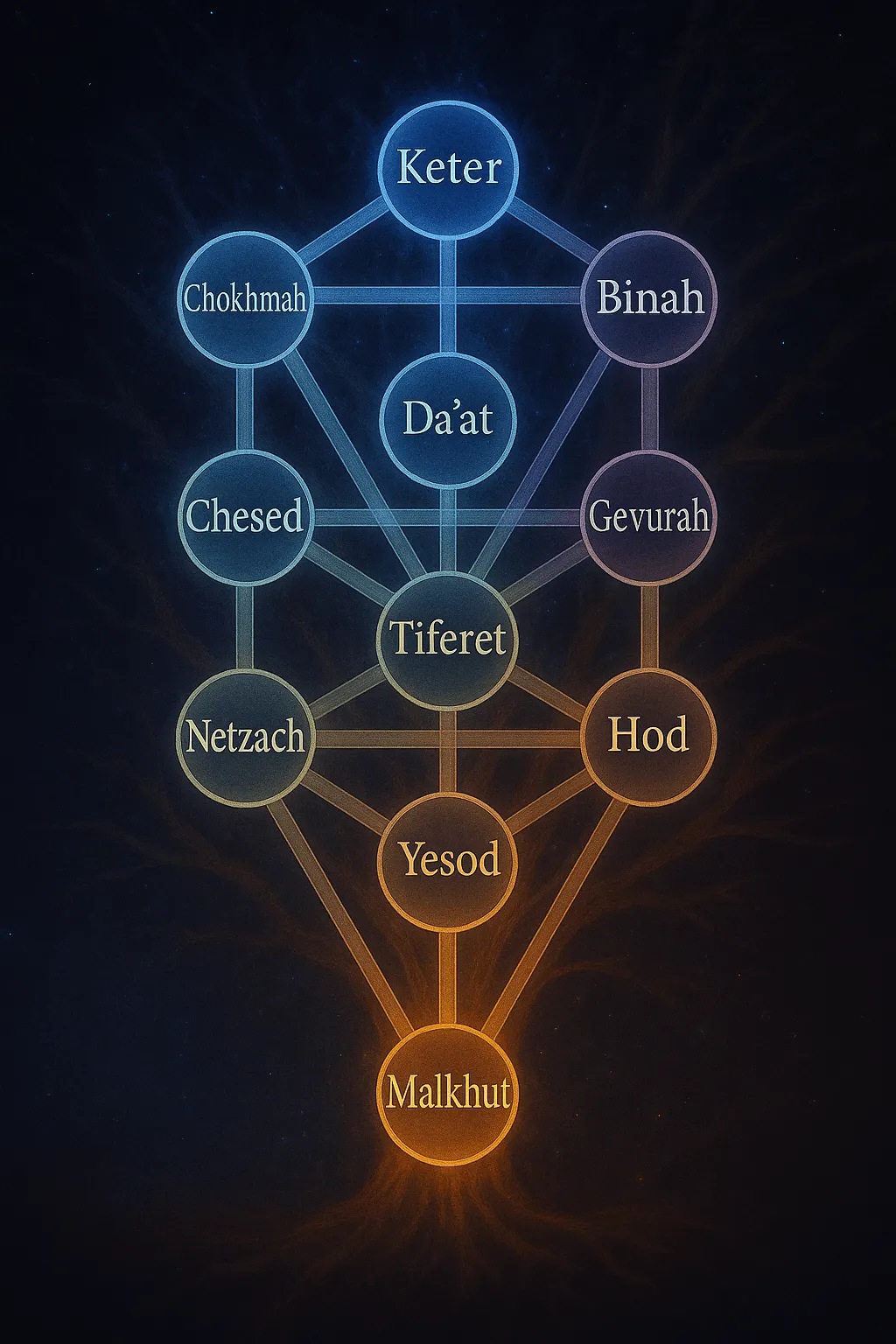
From this dance of circles and rays emerge the Sefirot—the structured vessels through which God’s light takes form. While our tradition speaks of ten core Sefirot, these are not limits but a template. The Infinite Light can express itself through an infinite number of Sefirot, each a unique facet of divine will.
Each universe, then, is built upon a different configuration of these Sefirot—like different blueprints drawn from the same infinite reservoir. Just as different melodies can emerge from the same musical scale, each world carries its own harmony, rhythm, and structure—yet all echo the One who wills them.
In our world, the ten primary Sefirot are:
- Keter – Will, the root of all
- Chochmah – Wisdom, the spark
- Binah – Understanding, the womb of form
- Chesed – Lovingkindness, the expansion
- Gevurah – Judgment, the contraction
- Tiferet – Beauty, the harmonizer
- Netzach – Endurance, the drive
- Hod – Glory, the receptivity
- Yesod – Foundation, the transmitter
- Malkhut – Kingdom, the receiver and birther of creation
But in other universes, different combinations of Sefirot may reign—giving rise to entirely different laws of nature, consciousness, and time. Each is a bubble floating in the vast Ayin, sustained by the breath of the One who is beyond all form.
4. The Descent of Worlds: From Divine Intellect to Physical Matter
Once divine light is structured through the Sefirot—shaped by Igulim (pure being) and Yosher (relational order)—it begins a journey of descent, from the highest abstraction to the most tangible form. This process unfolds through what Kabbalah calls the Four Worlds—each one a veil, a filter, a layer in the great metaphysical spiral from God to our reality.
Each world contains its own configuration of the Sefirot, each acting like a prism that refracts the Infinite Light differently. As the light passes through each layer, it becomes more specific, more defined, more veiled, until it reaches our material world.
1. Atzilut (אֲצִילוּת) – The World of Emanation
Atzilut is closest to the Source. It is not yet “creation” in any conventional sense. Here, the Sefirot are almost indistinguishable from the Infinite Light itself—like flame and glow. There is no separation, no duality. The divine light emanates, like rays from the sun, without leaving the sun behind.
This world is pure unity. There is no “self” or “other”—only God in relation to Himself.
2. Beriah (בְּרִיאָה) – The World of Creation
Here begins the first true sense of distinction. Beriah is where individuality and identity emerge, still in spiritual form. The divine light is now clothed in forms of intellect and archetype—the beginnings of mind, concept, and soul.
It is the world of the highest angels, the throne, and the beginnings of time and space in archetypal potential.
3. Yetzirah (יְצִירָה) – The World of Formation
In Yetzirah, the divine patterns begin to crystallize. Emotions, forms, and angels that embody aspects of the divine emerge. Here the Sefirot interact dynamically, and spiritual structures begin to resemble the outlines of physicality—like blueprints or schematics before building begins.
This is the world of movement, spirit, and the shaping of the energies that will enter embodiment.
4. Assiyah (עֲשִׂיָּה) – The World of Action
Finally, the light reaches Assiyah—our world. Here, the spiritual becomes material, and the vessels become opaque. In this world, God’s light is so deeply clothed that it can appear hidden altogether. Matter seems independent, time seems linear, and the soul feels separate from its Source.
But this is the very purpose of the whole descent.
Only in Assiyah can the full paradox of creation unfold: that something which seems “not-God” can still reveal God. That a finite, physical universe can become the home for the Infinite One. That the greatest concealment can become the greatest revelation.