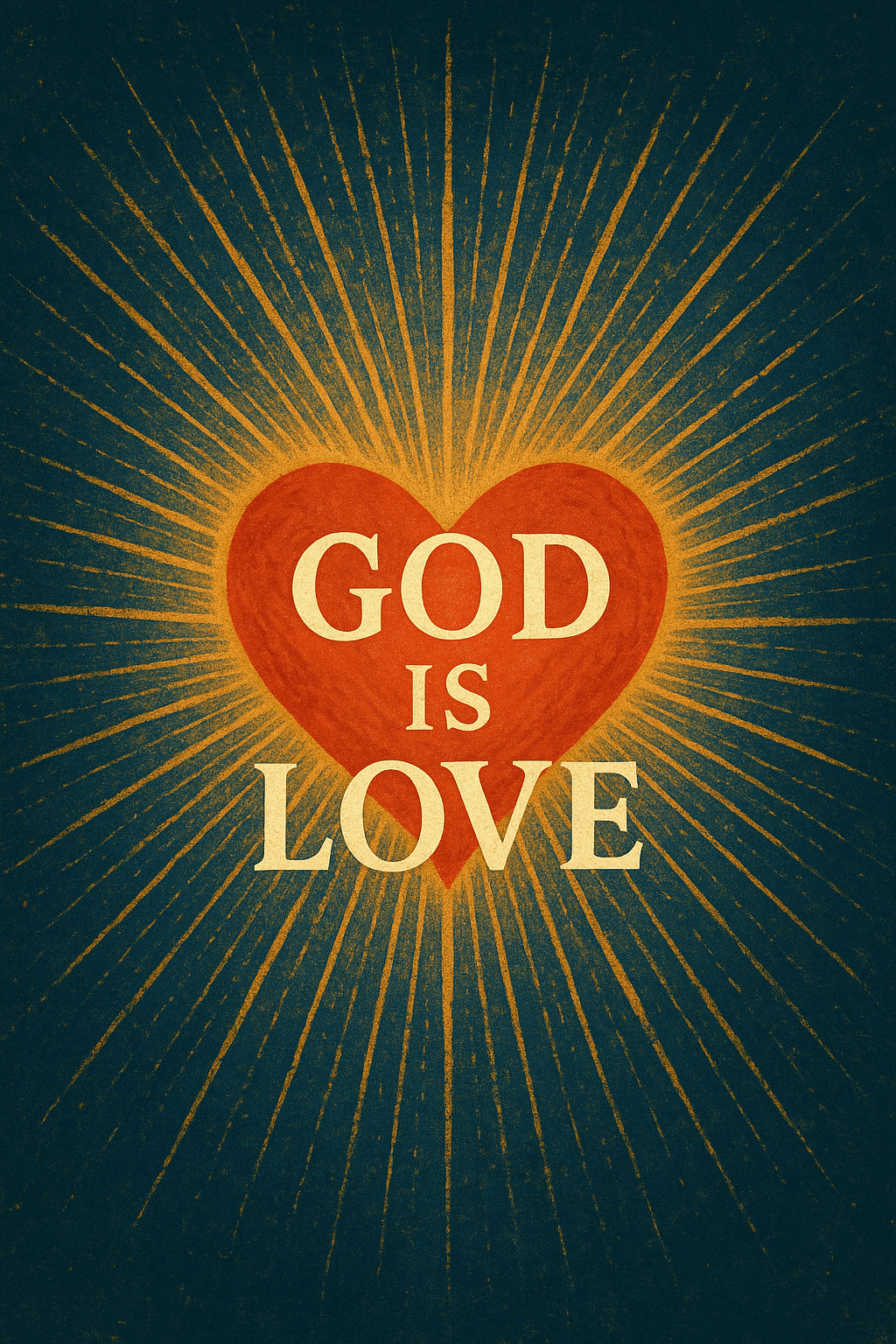

A Coherent Model of Agapē, Freedom, Justice, and Temporary Judgment
1. God’s Nature as Agapē (ἀγάπη)
Agapē in Greek means self-giving love, willed benevolence, and the desire for the flourishing of the other.
It is not primarily a feeling, but an active commitment to bring something toward its true good, its ultimate perfection.
So when Scripture says “God is love”, it does not mean God has loving emotions.
It means:
- God’s entire being is oriented toward giving existence, goodness, and flourishing.
- Everything God does is a movement of that love.
2. Love Requires Freedom
If God wants true love from creatures, not robotic compliance, He must give them:
- The capacity to choose,
- The capacity to reject,
- The capacity to cause good or harm.
Without the real possibility of refusal, love cannot exist at all—only programming.
So God’s gift of freedom is itself an act of love.
3. Freedom Entails Risk
If God gives freedom, then necessarily:
- Creatures can introduce moral evil into the world.
- Suffering can arise as a consequence of relational failure, pride, violence, injustice, or negligence.
This is not because God wills suffering as suffering, but because God wills freedom, and freedom inevitably allows the misuse of it.
Thus the existence of suffering says nothing about God’s lack of love—it says something about the dignity of the freedom He gave.
4. Love Allows Growth, Maturity, and Transformation
A world with no challenges, no consequences, and no resistance would produce:
- No virtue
- No moral maturity
- No courage, compassion, empathy, mercy, or wisdom
Soul-making requires:
- Hardship
- Tension
- Responsibility
- The ability to fail, learn, and rise again
Love permits the very conditions that make meaningful character and meaningful relationships possible.
So suffering is not good in itself, but it can produce good that could not exist otherwise.
5. Why Justice Does Not Contradict Divine Love
A world without justice would be moral chaos.
If God never brought consequences to the wicked and never defended the oppressed, then:
- Love would be powerless
- Evil would be victorious
- Moral responsibility would vanish
Justice is therefore a dimension of love, not its opposite.
Because God loves the oppressed, He must judge the oppressor.
Because God loves goodness, He must oppose evil.
Because God loves freedom, He must respect human choices—even when they harm others.
Love without justice becomes sentimentality.
Justice without love becomes cruelty.
God holds both in perfect unity.
6. Why Hell (or Judgment) Does Not Cancel Points 1–4 — When Hell Is Temporary Purification
Hell, in this model, is not eternal torture but the final, intense purifying encounter with God’s love.
It exists not because God stops loving, but because God loves too greatly to allow the sickness of sin to remain forever.
Temporary judgment is:
- The medicine strong enough to heal a will that resists gentler remedies.
- The final fire that burns away everything that keeps a creature from flourishing.
- The last boundary love erects against self-harm and harm to others.
So Hell is not God’s cruelty — it is God refusing to abandon any soul to its distortions.
Hell in this view affirms love because:
a. God’s love for the victim
Evil cannot be permitted to continue without consequence.
Judgment protects the innocent and upholds the moral fabric of reality.
b. God’s love for the sinner
Punishment is not rejection but restoration.
The fire is the fire of God’s presence — the same fire that heals the righteous burns away corruption in the resistant.
c. Freedom remains intact
God does not force a soul to love Him — but He also does not cease working for that soul’s healing.
Judgment is the “hard mercy” that confronts the will until it finally yields.
d. The moral structure of reality is preserved
Good and evil are not made equal.
Sin is not trivialized.
But neither is sin allowed the last word.
Thus:
- Justice defends the good,
- Judgment cures the evil,
- Purification restores the soul,
- Love remains the foundation of the whole process.
Therefore, temporary Hell does not contradict Points 1–4.
It fulfills them by ensuring every creature is ultimately healed, made whole, and restored to love.
7. The Restoration of All Things and the Final Sealing of Every Soul
If judgment is purification rather than eternal abandonment, then the end of God’s story is not destruction but restoration.
Scripture speaks of:
- “the restoration of all things” (Acts 3:21)
- “God being all in all” (1 Cor 15:28)
- “the reconciliation of all things, in heaven and on earth” (Col 1:19–20)
In this vision, the world to come is not merely a repaired universe — it is a transfigured one, where everything broken is healed and everything incomplete is brought to its perfection.
Restoration means:
- Every wound mended
All the suffering endured in the present world — every injustice, every grief, every regret — finds its answer in a world where nothing is wasted.Pain becomes seed; the harvest is joy. - Every soul made whole
When purification has completed its work, the soul finally becomes fully itself — free from distortion, fear, pride, addiction, and illusion.The human will, once fractured, is now integrated, luminous, capable of complete communion. - Every relationship reconciled
Love does not end with purification; it blossoms.Those who were once enemies can meet without fear.Those who caused harm can finally make amends.Every fracture in the human story is healed in the light of truth. - Creation restored to its original harmony
The natural world itself is renewed — no longer marked by decay, predation, or catastrophe.The “groaning” that Paul describes (Rom 8:22) resolves into peace. - The final sealing of every soul
Once the soul is healed and restored, it is “sealed” — not in a way that removes freedom, but in a way that perfects it.A will that has freely chosen the good in full clarity no longer desires evil.Freedom becomes stable, joyful, and incorruptible.
The final sealing is:
- The soul’s complete alignment with its true good
- Its unshakeable union with divine love
- The end of every possibility of self-destruction
This is the true meaning of eternal life:
Not endless duration, but endless flourishing.
Not a static paradise, but a living communion growing forever in depth, beauty, and intimacy with God.

